
Local coffee shops offer distinctive drinks, personal service, and a sense of neighborhood connection, yet many guests still choose chains because they make coffee easier to buy consistently, quickly, and through familiar ordering systems. The National Coffee Association reported in 2024 that 67% of U.S. adults had consumed coffee in the past day, while its research also found that 45% had consumed specialty coffee—evidence of a large market in which both everyday convenience and differentiated experiences matter. Understanding the choice means looking at convenience itself, the customer experience local cafés provide, and practical ways independent shops can reduce friction without giving up what makes them distinctive.
Convenience explains why guests choose coffee chains
Convenience is the reduction of time, effort, uncertainty, or difficulty involved in completing a purchase. In coffee retail, it includes how easily a customer can find a location, order, pay, collect a drink, and predict what it will taste like. It is not one feature but a cluster of benefits: speed, access, consistency, and low-effort decision-making.
This definition helps explain why a chain can win a visit even when a guest prefers a local café’s coffee. A familiar menu and repeatable process reduce the perceived risk of a rushed purchase. The National Coffee Association’s 2024 National Coffee Data Trends report describes coffee as a deeply established daily habit; when a product is purchased routinely, small differences in convenience can shape where customers stop.
Speed and predictable service
Speed is the time and effort required to complete an order, including waiting and resolving mistakes. Chains often design service around repeatable workflows, standardized menus, and high-volume ordering. That can be especially appealing during a commute or a short work break, when even a brief delay has a noticeable cost.
Predictability also matters. A customer who knows how to customize a drink, where to stand, and what the finished product is likely to taste like faces less uncertainty. This does not mean every chain visit is faster or every independent café is slower; the advantage is the customer’s expectation that the process will be familiar.
Digital ordering and payment
Digital convenience includes mobile ordering, stored payment details, order-ahead pickup, and loyalty accounts. These tools can shorten the perceived transaction by letting customers place an order before they arrive. Starbucks, for example, has built mobile ordering and rewards into its customer experience, illustrating how an app can connect ordering, payment, and repeat visits in one routine.
Digital systems are not automatically better for every customer: app use may require a smartphone, an account, or comfort with digital payment. Still, when guests value speed and a low-friction checkout, integrated technology can make a chain the simplest choice.
Location, hours, and familiar menus
Access is the practical ability to reach a business at the right place and time. A chain’s broader network may put a familiar option near a workplace, transit route, or highway. Longer or more predictable hours can also serve customers whose schedules do not match a neighborhood café’s operating day.
A familiar menu reduces decision effort as well. Customers can often anticipate the names, sizes, milk choices, and flavor options before entering. For a guest who wants a known drink rather than a new discovery, menu familiarity is itself a convenience benefit.
Local coffee shop experience builds value beyond the cup
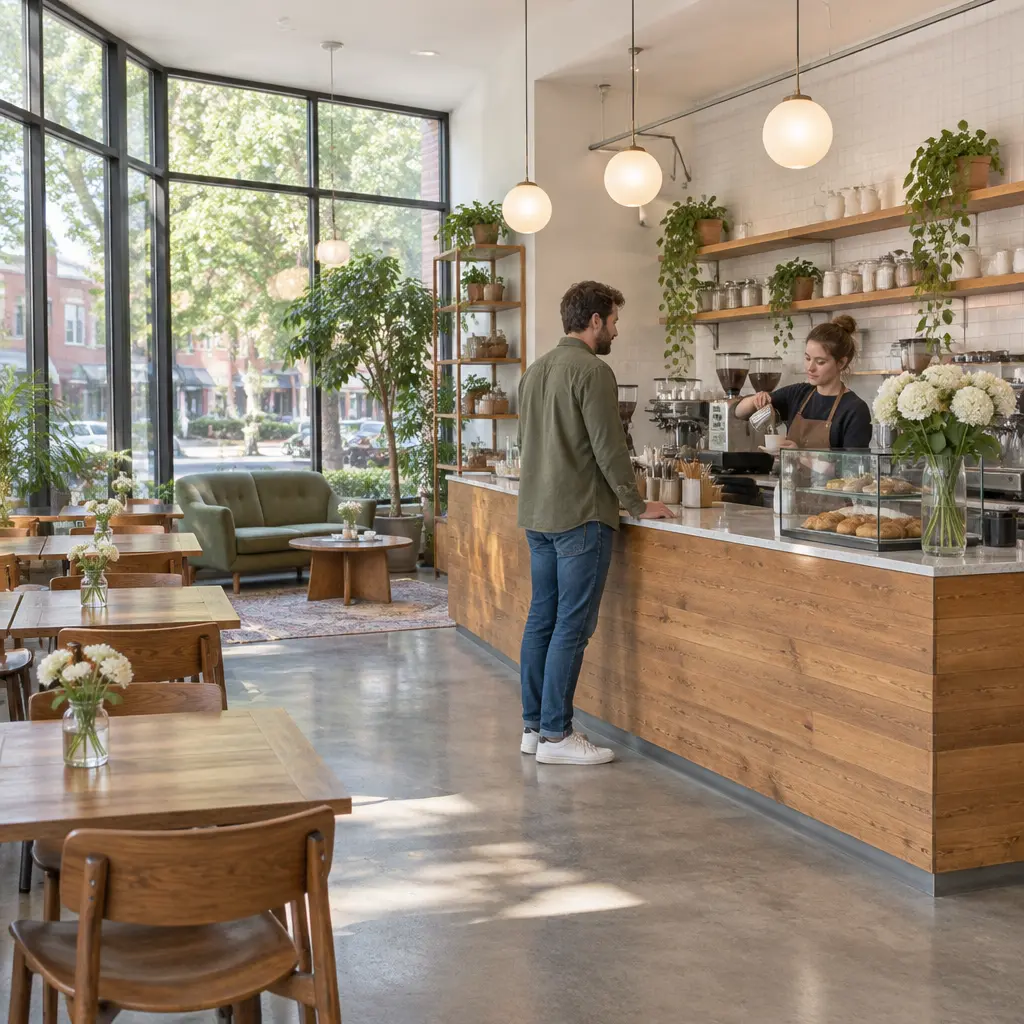
The local coffee shop experience is the combined impression created by a café’s beverages, service, atmosphere, identity, and relationship with its neighborhood. It can include skilled preparation, direct interaction with staff, locally distinctive products, and a place to pause or meet. Specialty coffee is one part of this wider experience, rather than a synonym for every local café.
The National Coffee Association’s 2024 report found that 45% of U.S. adults had consumed specialty coffee in the past day. That figure signals substantial interest in coffee beyond basic at-home or standard options, but it does not mean every customer prioritizes craft above speed. Local cafés compete most effectively when they make their distinctive value visible while keeping the visit straightforward.
Craft, product distinction, and choice
Craft refers to the knowledge and care involved in selecting, preparing, and presenting coffee. A local shop may offer rotating single-origin beans, carefully dialed-in espresso, house-made syrups, or brewing methods such as pour-over. These choices can turn a routine purchase into an opportunity to explore flavor and learn about coffee.
The benefit is strongest when the menu explains its options clearly. A long list of unfamiliar drink names can create decision friction, while concise descriptions, tasting notes, and staff recommendations help guests understand what makes an offering special.
Personal service and neighborhood connection
Personal service is an interaction that recognizes a guest’s needs rather than treating every transaction as identical. Remembering a regular’s order, explaining a bean’s flavor, or accommodating a reasonable preference can create a sense of recognition that a standardized transaction may not provide.
A neighborhood café may also participate in local life through community events, regional suppliers, or a welcoming place to meet. These features can strengthen emotional value, though they do not guarantee repeat visits: customers still need convenient hours, reliable service, and a product that suits their tastes.
Atmosphere and the café as a destination
Atmosphere is the sensory and social character of a space, including seating, lighting, noise, cleanliness, and the way guests are welcomed. For some visitors, a café is not merely a pickup point but a place to work, read, meet, or spend time between errands. Comfortable seating and a clear understanding of whether lingering is welcome can make the shop more useful than a quick-service stop.
The contrast is situational: a guest with ten minutes before a train may favor a chain’s rapid pickup, while someone meeting a friend may prefer a local café’s atmosphere. The same person can choose both on different occasions.
Guest choices reflect trade-offs, not simple loyalty
Coffee-shop choice is often a trade-off among time, price, quality, access, and experience. Customers may value a local shop’s distinctive coffee but select a chain when they are rushed, traveling, or seeking a known item. Conversely, they may choose a local café when service, atmosphere, or product discovery is more important than the shortest possible transaction.
The U.S. Bureau of Labor Statistics’ Consumer Expenditure Surveys track household spending across categories, including food away from home. Such national expenditure data provide useful context for consumer budgets, but they do not by themselves identify why an individual chose a chain over an independent café. Operators should therefore treat convenience as a likely influence to test locally, not as a universal explanation for every customer.
Occasion and time pressure
The purchase occasion changes what customers value. A commuter may prioritize proximity and pickup speed; a weekend visitor may care more about a seasonal drink or a comfortable table. Recognizing these different “jobs” helps cafés avoid assuming that every guest wants either a fast transaction or a long, immersive visit.
Perceived price and value
Perceived value is the customer’s judgment of what they receive relative to the money, time, and effort they spend. A lower posted price may attract attention, but value can also come from drink quality, portion size, friendly service, convenience, or an enjoyable place to sit. Clear pricing and transparent explanations of ingredients or sourcing help customers understand what they are paying for.
Because costs and menu prices vary by location and product, broad claims that local cafés are always cheaper or more expensive are unreliable. Shops can gather better evidence by reviewing transaction patterns, customer feedback, and sales by daypart and product category.
Local cafés can make convenience part of the experience
Convenience and local character are not opposites. An independent café can preserve personal service and distinctive coffee while removing avoidable delays and uncertainty. The goal is not to imitate every chain feature; it is to make the most valuable parts of the local experience easy to access.
Simplify the path from arrival to pickup
A clear menu, visible ordering point, readable pickup area, and accurate wait-time estimate help guests move through a visit confidently. For a small operation, even basic improvements—such as highlighting bestsellers, separating pickup from ordering, or preparing popular items consistently—can reduce confusion without requiring an expensive app.
Use technology selectively
Technology is most useful when it solves a real customer problem. Online menus, contactless payment, order-ahead options, and simple digital rewards can help regulars, while maintaining a welcoming in-person option serves guests who prefer conversation or cash. Shops should assess staffing, order volume, fees, and the risk of overwhelming the bar before adding new tools.
Make distinctive products easy to understand
A concise menu can communicate both familiarity and discovery. A café might identify a dependable everyday espresso drink, explain one rotating seasonal feature, and offer staff guidance for less familiar brewing methods. This gives time-pressed guests an easy choice while leaving room for curious customers to explore.
Measure the experience with local evidence
Owners can track wait times, repeat visits, order accuracy, busy periods, and customer comments to learn where convenience breaks down. A short survey or informal question at checkout can reveal whether guests want earlier opening, faster takeaway service, clearer menus, or more seating. These measures are more actionable for an individual shop than assuming national coffee trends describe its own customers exactly.
Conclusion: convenience and character can coexist
Guests continue to choose chains because convenience combines speed, predictable service, digital ordering, broad access, and familiar menus. Local coffee shops can answer with craft, personal service, neighborhood connection, and atmosphere—but those strengths matter most when customers can access them without unnecessary friction. Coffee habits and specialty demand show that the market supports more than one kind of experience; individual choices depend on the occasion and the value each guest perceives.
For café owners, the practical next step is to observe the customer journey, ask guests what slows them down, and improve the parts of service that matter most while protecting the shop’s distinctive character. For readers, comparing local cafés and chains across different occasions can reveal which combination of convenience, quality, and atmosphere best fits each visit.
Sources: National Coffee Association, 2024 National Coffee Data Trends Report, https://www.ncausa.org/Research-Trends/Market-Research/NCDT; Starbucks, Starbucks Stories: Mobile Order & Pay, https://stories.starbucks.com/stories/2015/starbucks-mobile-order-pay/; U.S. Bureau of Labor Statistics, Consumer Expenditure Surveys, https://www.bls.gov/cex/.