
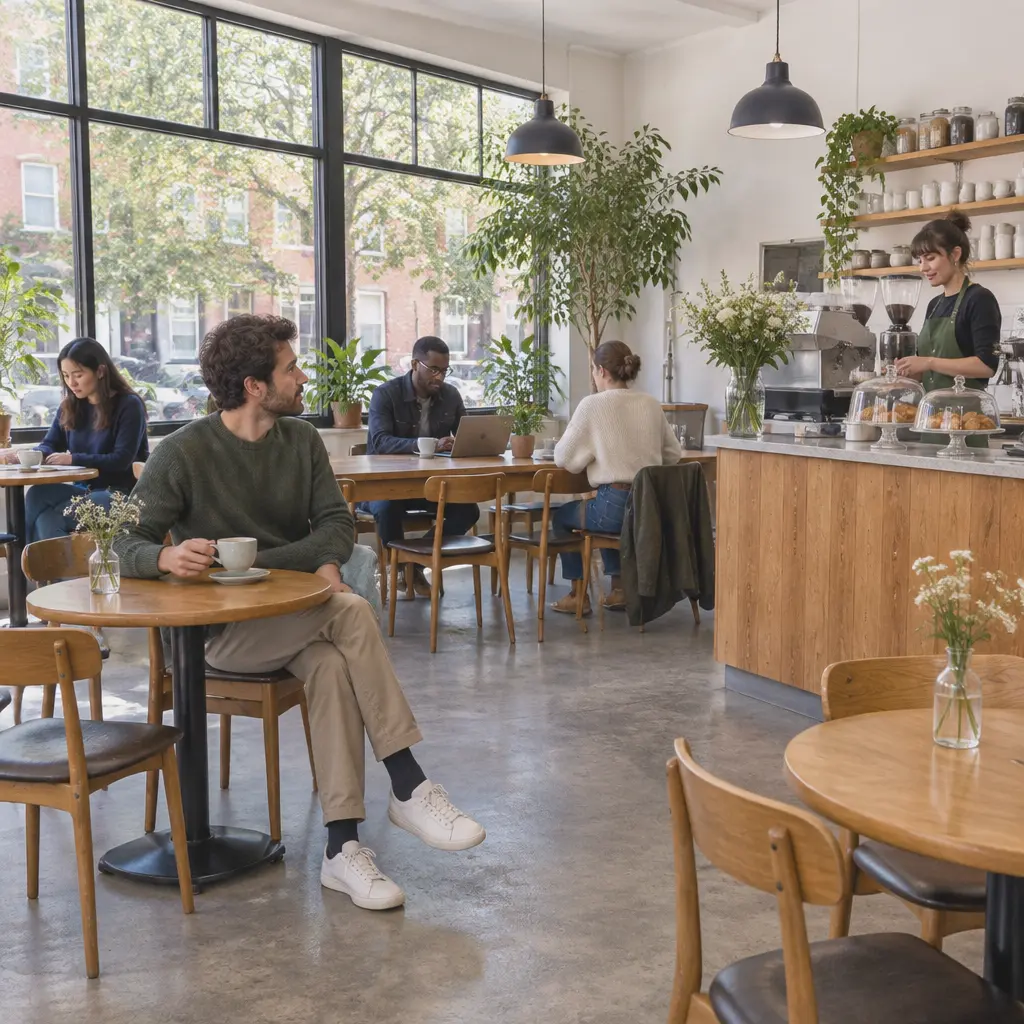
Coffee shop regulars culture is the informal set of routines, relationships, and expectations that develops among repeat customers and staff in a neighborhood café. For newcomers who feel like outsiders, that culture can look like a closed circle—but research on “third places,” social connection, and loneliness suggests that familiar public spaces can also help people build low-pressure ties. A welcoming café does not require newcomers to become instant friends with everyone: small rituals, respectful conversation, and inclusive design can make belonging easier. This article explains how regulars culture forms, why it can feel exclusionary, what newcomers can do, and how cafés can turn everyday routines into more open community life.
How Coffee Shop Regulars Culture Builds Belonging
Sociologist Ray Oldenburg described a “third place” as a setting outside home and work where people can gather informally. In his account, cafés and similar places can support casual conversation, repeated encounters, and a sense of local attachment. A regulars culture is one possible result: customers recognize one another, learn staff routines, and develop shared expectations about how the space is used. It is not automatically a close-knit community, and it does not mean every customer wants to socialize.
The distinction matters because repeated exposure can create familiarity without immediate intimacy. A 2023 U.S. Surgeon General advisory on social connection reported that roughly half of U.S. adults experienced loneliness even before the COVID-19 pandemic. That finding does not show that cafés solve loneliness, but it underscores why accessible everyday gathering places matter. The most welcoming cafés allow both conversation and solitude, so newcomers can participate at their own pace.
Rituals and recognition
Rituals are repeated, recognizable actions: ordering the same drink, visiting after a morning walk, greeting the same barista, or sitting at a familiar table. Over time, these small repetitions make a place feel predictable. Staff may remember a customer’s usual order, while customers begin to recognize familiar faces. Recognition can provide a gentle opening for connection, but it should not be mistaken for an obligation to disclose personal information or join a group.
Weak ties and casual conversation
A weak tie is a light social connection—such as exchanging greetings or brief conversation with someone known by sight—rather than a close friendship. Sociologist Mark Granovetter’s influential work on “the strength of weak ties” examined how connections beyond one’s closest circle can carry useful information and link otherwise separate networks. In a café, a short chat about the weather, a community notice, or a book can be meaningful without creating pressure for a deeper relationship. Newcomers can treat these exchanges as optional invitations, not tests of acceptance.
Shared space and local identity
A café can become part of local identity through recurring events, neighborhood bulletin boards, familiar staff, and visible support for nearby organizations. These features make the venue more than a place to buy coffee: they connect it to the surrounding community. However, a strong local identity can also make an unfamiliar visitor feel that everyone else already knows the rules. Clear signage, public event information, and staff who welcome first-time guests help make that identity easier to enter.
Why Regulars Culture Can Feel Exclusionary to Newcomers
A café’s social atmosphere is shaped by more than friendliness. Seating arrangements, ordering routines, noise, price, accessibility, and the behavior of established groups all influence whether someone feels welcome. A newcomer may interpret a crowded table or an inside joke as a signal to stay away, even when no one intends to exclude them. Recognizing these structural and social cues helps separate actual unwelcoming behavior from the ordinary uncertainty of entering an unfamiliar group.
Unspoken rules and insider knowledge
Unspoken rules are expectations that regulars understand but that are not clearly posted—for example, where to queue, whether laptop use is acceptable, or how long customers are expected to occupy a table. These conventions can make a place run smoothly for established customers while confusing first-time visitors. Cafés can reduce the friction with simple cues, such as visible ordering instructions, signs about shared seating, and clear information about peak hours or laptop policies.
Closed groups, social anxiety, and misread signals
Regulars may arrive with friends and focus on one another rather than scanning the room for someone new. That behavior is not necessarily rejection, but it can feel like a closed door to a person hoping to connect. Social anxiety may intensify uncertainty about when to speak or whether a greeting is welcome. A practical approach is to begin with low-stakes contact—such as asking staff about a menu item or commenting briefly on a shared event—and then respect the other person’s response. A short reply or lack of follow-up is a cue to let the interaction end comfortably.
Access, affordability, and the right to belong
Belonging is also affected by who can comfortably use a café. Prices may exclude people on tight budgets; inaccessible entrances or restrooms can exclude disabled visitors; and a lack of seating, language access, or visible welcome to different age groups can narrow participation. The U.S. Access Board’s accessibility standards provide requirements for accessible facilities, while the broader principle is straightforward: a community space is more welcoming when people can enter, navigate, and use it without unnecessary barriers. Inclusion should not depend on a customer’s ability to spend heavily or perform a particular social style.
How Newcomers Can Find Their Place Without Forcing It
Joining a regulars culture does not require changing your personality or becoming a frequent customer immediately. Familiarity usually grows through repetition, and participation can remain modest. A useful goal is to become comfortable in the space first; conversation and relationships may follow naturally, but they are not the only measure of belonging.
Start with a comfortable routine
Choose a time and seating area that suit your needs, learn the ordering flow, and return when it feels enjoyable rather than obligatory. A predictable routine can reduce the mental effort of entering an unfamiliar place. If the café is busiest at a particular hour, visiting at a quieter time may make it easier to learn the layout and speak with staff.
Use small, context-based openings
Brief comments tied to the setting are often easier than introducing yourself to an entire group. You might ask whether a chair is free, compliment a drink, or ask about a flyer for a local event. Keep the exchange open-ended but easy to end. If the other person responds warmly, continue; if not, return to your own activity without treating the moment as a verdict on your worth or on the café as a whole.
Try organized activities and community events
Book clubs, open-mic evenings, language exchanges, craft sessions, and volunteer meetups provide a shared topic and clearer social expectations than an unstructured room. Ask whether events are open to first-time visitors, whether registration is needed, and whether there is a cost. Organized activities are not a guaranteed route to friendship, but they can make conversation easier because participants already have something in common.
How Cafés Can Make Regulars Culture More Inclusive
A welcoming atmosphere is not solely the newcomer’s responsibility. Café owners and staff shape the conditions for connection through layout, service, policies, and programming. They can preserve the comfort that regulars value while making the space legible and accessible to people who have never visited before.
Make first visits easy to navigate
Clear menus, visible queues, accessible seating, and friendly explanations of house policies help reduce uncertainty. Staff need not act as hosts for every interaction, but a simple welcome and an answer to practical questions can make a first visit feel less intimidating. A range of seating options—communal tables, small tables, and places suited to solo visitors—supports different levels of social engagement.
Create invitations without demanding participation
Community boards, public event calendars, and occasional hosted gatherings let customers choose whether to engage. The design principle is invitation, not pressure: a person should be able to attend an event, sit quietly, or leave without having to explain themselves. Staff can also set respectful norms around harassment, noise, and shared seating so that a few regulars do not unintentionally claim the entire space.
Notice who is missing
Owners can review practical barriers by asking who appears to use the café and who may be unable to do so. Feedback from disabled customers, older adults, families, students, and people from different language communities can reveal problems that a familiar clientele may not notice. This is not a matter of assigning customers to demographic categories; it is a way to check whether the space’s hours, pricing, layout, and communication genuinely serve the neighborhood.
Conclusion: Belonging Can Begin with Small, Repeatable Moments
Coffee shop regulars culture grows from rituals, recognition, weak ties, and shared use of a neighborhood space. Those same features can feel intimidating when expectations are unspoken or established groups seem closed. Newcomers can begin with a comfortable routine, brief context-based conversation, or an organized event; cafés can help by making rules, access, and invitations clear. The wider lesson is that community does not always begin with instant friendship. It can start with a familiar face, a respectful greeting, and the freedom to participate at one’s own pace. If a café does not feel welcoming after repeated visits, it is reasonable to try another space or a structured community activity—and cafés can use customer feedback to make belonging more attainable.
Sources: Ray Oldenburg, The Great Good Place: Cafés, Coffee Shops, Bookstores, Bars, Hair Salons, and Other Hangouts at the Heart of a Community, 1989, https://www.paragonhouse.com/9781569246818; U.S. Department of Health and Human Services, Our Epidemic of Loneliness and Isolation: The U.S. Surgeon General’s Advisory on the Healing Effects of Social Connection and Community, 2023, https://www.hhs.gov/sites/default/files/surgeon-general-social-connection-advisory.pdf; Mark S. Granovetter, “The Strength of Weak Ties,” American Journal of Sociology, 1973, https://doi.org/10.1086/225469; U.S. Access Board, Americans with Disabilities Act Accessibility Standards, https://www.access-board.gov/ada/.